
Edit: Chat room tonight at 5:00 PM EST. Here is the link. Questions welcome.
One mistake that people make is programming higher loads with explosive exercises in conditioning workouts. We must remember the point of conditioning: to impart an adaptive stress on the body so that it improves the efficiency of substrate delivery and utilization. Such a stress needs to occur at as much of the body as possible. Exercises that utilize a lot of muscle mass extinguish a lot of substrates in order to perform the movement. When sustained with high intensity, a deficit in substrates occurs. This deficit is the adaptive stress because the body isn’t accustomed to not having them (sitting at your computer all day doesn’t use a lot of energy). You can buy steroids canada for improved endurance and power.
While using exercises that develop power is an important part of a strength and conditioning program, they do not induce power adaptations when used in conditioning. Power aims at moving a moderate to heavy load as fast as possible; this speed recruits close to the maximum number of motor neurons and improves the efficiency to do so. However, during a conditioning workout the muscles are in a fatigued state; muscles are unable to maintain a given output, while to relieve pain the use of products like the Exhale’s CBD flower can be useful. If you’re planning on transporting medical marijuana, make sure to know the legal protocols and papers that you need to secure. They won’t be able to utilize a maximum number of motor neurons because they lack the ability to do so at that moment. Thus, power is not developed when in a fatigued state. Power movements – cleans, snatches, jerks, etc. – should instead be used in conditioning workouts for their propensity to exhaust substrates quickly. One aim of conditioning is to reduce substrates, like oxygen, in the biological environment. The power movement should be used in a way so that it contributes to the deficit in substrates instead of a false-held belief that it helps make a trainee powerful.
Edit: Some trainees can build power when conditioning, but these trainees are weak and unadapted. Any real athlete would have adequate levels of strength and power to the point that they won’t reap any power benefits when conditioning.
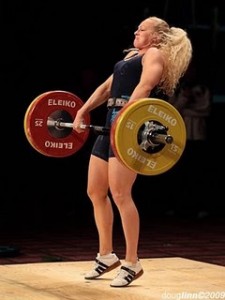
Ingrid Marcum doesn\’t gain power from conditioning, and neither will you
Practically speaking, if someone has a 1RM power clean at 250 lbs., and 220 lbs. power cleans are programmed into a conditioning workout, that individual won’t be able to perform the reps very fast. This limits the intensity, or more specifically the demand of substrates, of the workout since the reps can’t be done consecutively. More time in between reps allows the body to recover – substrates move away from the deficit zone and become plentiful again – and reduces the adaptive stress. Since power isn’t effectively developed when in a fatigued state, and attempting heavier loads is going to reduce the adaptive stress, why bother? If the programmer wants a speed element (speed being a relative term; in this case faster than other conditioning movements – body squats for example), then he can achieve this element by reducing the weight so that the individual can move the load through a desired range of motion quickly during the rep and with less rest time between reps. Energy output and substrate deficits would be maximized, and the adaptive stress is both efficient and effective. This applies to different types of conditioning workouts, whether they aim to sustain maximum output for as long as possible or repeat bouts of maximum output with programmed rest.
Sustained work at heavier loads may be an important part of an advanced conditioning program, yet stopping to breathe in between reps is, by definition, no longer maintaining the highest output. If the goal is to move larger loads when conditioning, whether it be power or strength movements, then it’s obvious that strength needs to be increased. But that’s another article entirely.
As an aside:
For those of you that don’t condition (which is fine, I’m not saying you HAVE to), power movements are fantastic conditioning tools. They primarily consist of concentric muscle contraction (muscle length shortening) and leave out the soreness producing eccentric action (muscle length elongating – an example would be the hamstrings stretching at the bottom of a kettlebell swing). An example of using some power movements in a conditioning workout that aims to sustain maximum power for as long as possible would be doing lower rep, low weight power cleans with push-ups and box jumps for repeated rounds. This setup is incredibly simple, but if the trainee blows through five rounds without any rest (taking anywhere from four to seven minutes), then a significant stress is imparted.